

 With April 15th now just around the corner, many Americans are either starting to file their returns or dreading the experience. Beyond the confusion and stress that can often accompany tax time, another reason for the despair is the possibility that you may end up owing the IRS money that you don’t have. Unfortunately this scenario is becoming more common and taking taxpayers by surprise.
Although some Americans will actually end up paying less in taxes due to the Tax Cuts and Jobs Act of 2017, the trouble is that few adjusted their withholdings after the law took effect. In fact a study by NerdWallet found that just 16% of workers changed their federal tax withholdings last year. As a result not only have there been widespread reports of taxpayers seeing smaller refunds but there may also be some that find themselves owing.
Because of this there are likely many who are wondering what they can do when they’re hit with a tax bill they can’t afford. While it’s not a great position to be in, the good news is that there may be hope. Let’s take a look at a few potential options.
Tax Repayment Plans and Tax Debt Relief Options
Short-term or long-term payment plans
The first and perhaps the most straightforward option you have for you paying off your tax bill is setting up a payment plan with the IRS. There are actually two different plans offered by the agency, although there are restrictions on who can qualify and there may be fees depending on the plan. These two basic options are:
- Short-term payment plan (120 days or less)
- Long-term payment plan (More than 120 days)
First, the short-term plan has greater availability to taxpayers. Plus the set-up fee for these plans is $0 regardless of whether you apply online, by phone, by mail, or in person. However you will be assessed any penalties and interest that accrue while your balance is outstanding. In many cases monthly payments for these plans can be made via a checking account transfer, check, money order, or debit card/credit card (note: additional fees may apply for card payments), although those who owe more than $25,000 will only be able to make payments via direct debit from their checking account.
Meanwhile requesting a long-term plan includes a few more requirements and fees. For one, you must owe less than $50,000 in taxes, penalties, and interest. You must also have filed all required returns. If you elect to have automatic monthly withdrawals from your checking account (this is known as a Direct Debit Installment Agreement) there’s a $31 set up fee when applying online or $107 setup fee when you apply by phone, mail, or in person. Proceeding without a DDIA may result in a $149 setup fee online and a $225 setup free by phone, mail, or in person. That said, low-income individuals may have these fees waived or reimbursed based on certain conditions.
In addition to payment plans for individuals, there are separate plans for businesses. However the IRS notes that sole proprietors or independent contractors should apply as individuals instead of businesses. It’s also worth noting that the amount owed limits for these business plans are lower than those for individuals.
Revisements and reinstatements
Even after you’ve arranged your payment plan, the IRS may still allow you to make changes. That said you may be assessed a fee for doing so. There is a $10 fee to restructure an existing plan when you apply online or an $89 fee via other mediums. In the unfortunate event that you default on your initial plan and wish to reinstate it, these same fees will be assessed as well.
 Offer in Compromise
If a regular repayment plan isn’t a viable option for you, another route you can pursue is known as an offer in compromise. This avenue can best be described as debt settlement, allowing you to negotiate with the IRS and have them forgive a portion of what you owe. As you can imagine this option comes with a number of restrictions, requirements, and more to consider.
Starting with eligibility, there are a few basic requirements to be aware of before submitting an offer:
- You must file all of the tax returns you are legally required to file
- You must have received a bill for at least one tax debt included on your offer
- Those in bankruptcy proceedings are not eligible to submit offers
- You must have made all required estimated tax payments for the current year (if applicable)
- Business owners with employees must have made all required federal tax deposits
It also goes without saying but those who are determined to be able to pay their tax bill in full will not be eligible to offer a compromise.
When submitting an offer, you may be required to submit an application fee. Currently this fee is $186, although those who meet the Low-Income Certification standards are exempt. Low-Income Certification is determined by your gross monthly income, the size of your family unit, and your location. For example a family of four with a gross monthly income of equal to or less than $5,063 living in the contiguous United States would be eligible (that level increases to $5,823 for those in Hawaii and $6,329 for families in Alaska). A major exception to this is that sole proprietors do not qualify for Low-Income Certification waivers
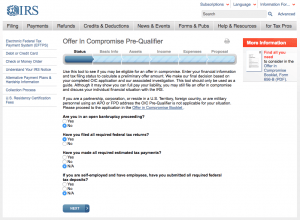
Given this application fee, it’s good to know that the IRS has an Offer in Compromise Pre-Qualifier tool you can use to ensure that you don’t waste more money by submitting an offer when you’re unqualified. This tool will walk you through some basic info, ask for some details on your income, amounts owed, and other assets, and then provide you with a sample of what to present as your offer. It may also refer you to the IRS’s Offer in Compromise booklet with even more information to know before and while preparing your offer.
Tax debt relief companies
For those who don’t feel comfortable pursuing their own offer in compromise or have failed to reach an agreement with the IRS, tax relief companies may be able to help. According to SuperMoney, in 2015, the IRS accepted 40.3% of Offer in Compromise proposals it received. However that figure increased among those who utilize the right tax relief company.
Hiring a tax relief company will give them power of attorney privileges to negotiate on your behalf. Another benefit is that these CPAs and attorneys are well-versed in the IRS paperwork that may be daunting to most others. Similarly their experience can also give them greater insight into what types of offers the IRS will accept, helping ensure that your compromise is reached.
Of course, like any service, tax relief help comes at a cost — sometimes thousands of dollars. What’s more, citing the Federal Trade Commission, Credit Karma warns that companies soliciting tax debt relief may not be as reputable as they appear. Because of this you should not only be wary of upfront payments and do your due diligence on any company you’re considering. Keep in mind you also need to assess the costs associated with hiring professional help to determine if it’s worth the investment.
Being saddled with tax debt is never a fun experience — but it can be even worse when you don’t see it coming. Thankfully the IRS may be more understanding of your circumstances than you assume, and they do offer a few different options to help you pay off your tax debt without feeling their wraith. As a reminder it’s also a good idea to take this opportunity to update your tax withholdings with your employer or, for those who are self-employed, look into whether you should be making estimated quarterly tax payments to prevent a nasty April surprise.