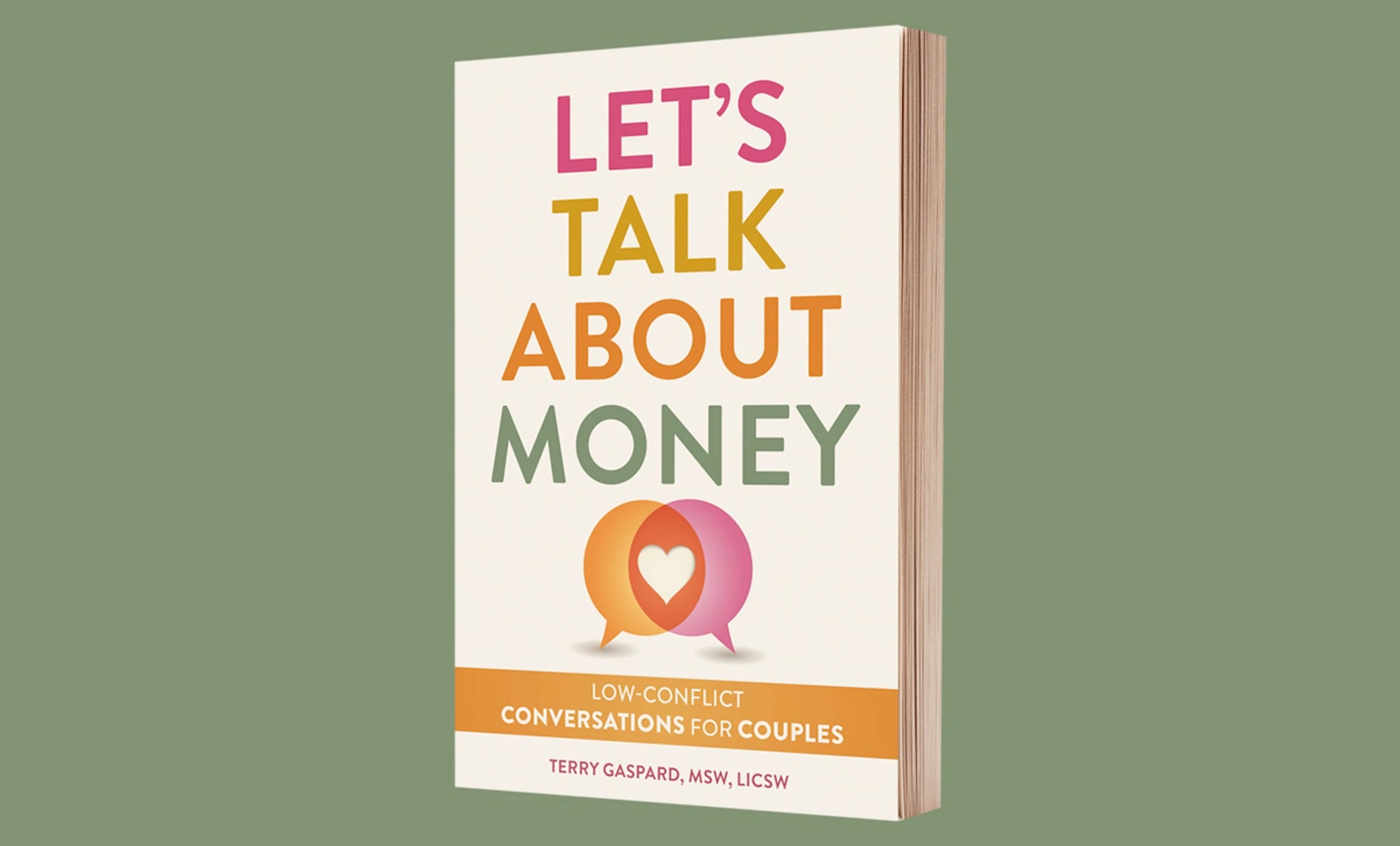

Every so often, I realize how blessed I am to have a spouse I see (basically) eye to eye on financially. Unfortunately, not everyone is so lucky. Enter the new book Let’s Talk About Money: Low-Conflict Conversations for Couples by Terry Gaspard MSW, LICSW, released earlier this year. I had a chance to check out Let’s Talk About Money in audiobook form, which is apparently an Audible exclusive.

If you, like me, didn’t know what those extra letters after Gaspard’s name meant, they translate to “Master of Social Work” and “Licensed Independent Clinical Social Worker.” But, while Gaspard is a licensed mental health professional, the author does warn that the book isn’t a replacement for actual therapy.
Like multiple books I’ve reviewed, Let’s Talk About Money first invites readers to discover and understand their “money story.” Basically, a look back at how different past experiences may have impacted your relationship and habits with money now. This transitions into another popular topic: money scripts. These are similar concepts, but give you a shorthand for explaining your overall beliefs. There are four money script categories — Money Avoidance, Money Worship, Money Status, and Money Vigilance — you’ll hear Gaspard refer to regularly throughout the rest of the book.
To determine your money script, you’ll be invited to take a quiz, which is included in the accompanying PDF. One thing that did catch me a bit off guard about this was that, in other audio productions I’ve heard, the narrator will still basically read through all of the questions, even if you can’t exactly answer them in audio form. Yet, in this book, it jumps straight into the scoring explanation without covering the questions themselves. Because of this, I’d recommend having that document at the ready so you pause the book, take the quiz, and then resume playback. Otherwise, these segments won’t make a whole lot of sense.
Since matters of money have been known to cause arguments among couples, a good portion of Let’s Talk About Money is devoted to providing couples with tools to better have these conversations. That includes techniques for lowering the temperature in the room when disagreements do crop up, so that emotions don’t get in the way of important talks. For example, Gaspard suggests having an agreed-upon phrase that partners can use as a “reset” when things are getting off track. I also appreciated the advice that couples should remember that they are a team fighting a problem, not each other.
Interestingly, while a good portion of the book focuses on learning about your personal relationship with money and, in turn, how to discuss financial matters with your partner, there is one section where Gaspard transitions into some direct tips on budgeting and saving money. This comes in chapter 6 titled “Develop a Savings Plan” and offers ways to save on groceries, gasoline, traveling, and more. To my surprise, some of these were ones I hadn’t heard! For one, I was introduced to the platform FlashFood (although it doesn’t seem to be available in my area). Gaspard also recommends using self-checkout, as those who do tend to pay more attention to how much they’re actually spending. That’s something I actually hadn’t thought about, but it makes perfect sense!
While we’re talking about random things I learned from the book, I also wasn’t aware that it was none other than Senator Elizabeth Warren who helped popularize the 50/30/20 budget! Perhaps I heard that somewhere before, but it blew my mind nonetheless.
Throughout the book, you’ll hear stories from several couples that Gaspard spoke to. These real-life examples definitely ground the lessons and provide some relatable examples. That said, since these are real people with common problems, there are times when you may think you’re hearing the same tale again, even if it’s not. Adding their money script signifiers to each person probably doesn’t help this (very minor) issue either, as it starts to sound a bit repetitive. Thankfully, it never gets to a truly annoying level and was likely also heightened by my binge-style of listening to the book.
Overall, this isn’t the type of book that will give you a roadmap toward fixing your finances — but it will give you some tools for better understanding your money tendencies and help you to communicate with your partner so that you can fix your collective money together. Indeed, Let’s Talk About Money: Low-Conflict Conversations for Couples is just as much about argument escalation and how to use appropriate confrontation tactics as it is about finance. On that note, I’d say it strikes a strong balance, offering something unique to couples at any stage of their relationship. So, whether you’re preemptively learning how to have money convos with your partner (maybe even a future partner) or want help learning how to address money issues present in your relationship, I do think Let’s Talk About Money could be a great asset to you. Then, if you want to dive deeper on financial “how tos,” you can pick up another great book to advance your journey.

- Learn more about your money story and money script
- Provides tools and techniques for discussing finance with your partner
- Some stories from couples can feel a tad repetitive
- Mostly not a how-to on finance itself